
One of the questions I get asked most when people see The Bonsai Shack is where the idea came from. Unlike many of my previous artworks, it didn't begin with a finished picture in my mind. When I'm working on paper or canvas, I usually spend a lot of time planning the composition. I'll sketch ideas, map everything out, and gradually build the artwork piece by piece.
For this project, I wanted to work differently. Instead of planning the entire composition, I divided the skateboard vertically into three sections and began studying the wood grain. I spent time turning the board, following the natural lines and textures in the grain, waiting to see what shapes would begin to emerge. Rather than imposing an idea onto the wood, it felt like I was discovering one.
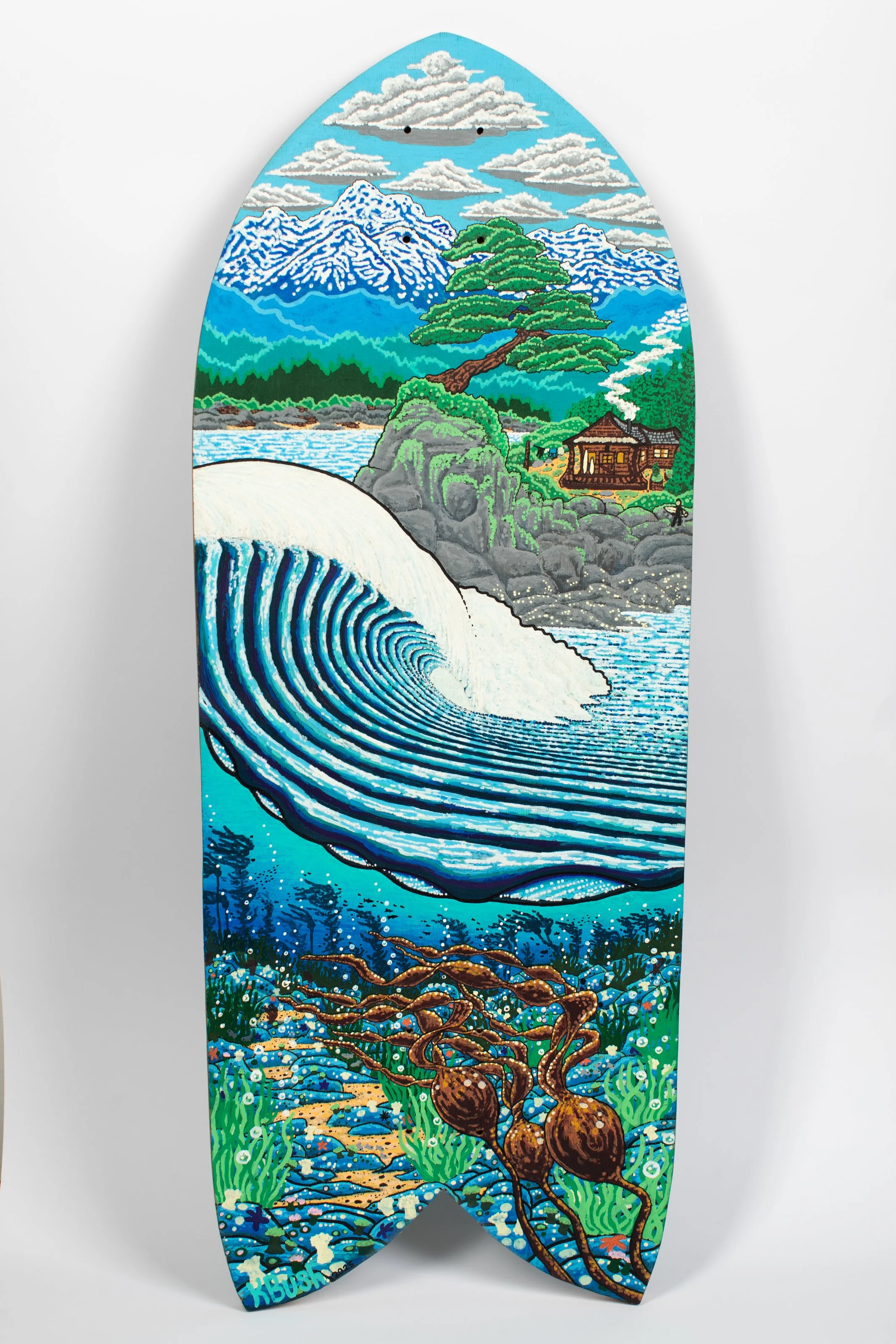
As I spent more time with the board, the composition gradually revealed itself. The rugged shoreline, the rock stack supporting the bonsai tree, the layers of forested hills fading into distant mountains, and the reflections dancing across the water all emerged one section at a time. There were days where I spent more time looking than drawing. I'd wait until something felt right before making the next mark.

One of my favourite details almost disappears into the background. Tucked away is a small cedar cabin inspired by the place I lived during my second and third years in Tofino. The cabin sat on North Chesterman Beach and had been built by a local wood carver sometime in the '80s or '90s. Cedar shakes covered both the exterior and interior, a driftwood tree trunk supported the centre of the house, and a woodstove kept it warm through the winter.
It wasn't always comfortable. During heavy storms the roof would sometimes leak, and I'd scatter pots and buckets around the floor to catch the rain. The spiders were enormous, and the wind and rain became their own soundtrack.
Some of my favourite memories from that cabin came during those storms. When the power went out, I'd sketch by candlelight or headlamp, listening to the wind in the trees and the rhythm of the rain on the roof while waiting for the weather to pass. Looking back, I wouldn't change any of it. Living there taught me to pay attention to the coast in a different way. Surfing became less about checking a forecast and more about understanding what was happening in my backyard.
Versions of that cabin have quietly found their way into several of my paintings over the years. They've become less about one specific place and more about the old West Coast cabins that were once scattered throughout Tofino and the Canadian surf coast. Many of those cabins have disappeared, but they remain part of the culture that shaped surfing here. Including one in The Bonsai Shack felt like a small tribute to that era and to a place that played such an important role in my life.

Over roughly three months, the skateboard became the piece it is today. Every line was drawn by hand using Posca paint markers and ink. Because I wasn't working from a finished plan, each completed section naturally guided whatever came next. As a photographer, I've realized that much of my creative process comes from observation. You can't force good light or good waves. You pay attention, wait, and recognize them when they appear.
Working on The Bonsai Shack reminded me that illustration can be approached in much the same way. Instead of waiting for the ocean to reveal something, I found myself waiting for a piece of wood to do the same.

Looking back, The Bonsai Shack reminded me that not every artwork needs to begin with a finished plan. Sometimes the most rewarding projects come from slowing down, paying attention, and letting the process unfold one detail at a time.
Thank you for following along.
— Keenan